The Ministry of Ecclesiastical Endorsement: Location and Language - Part 1
Where It Sits Matters
Governance, Authority, and the Location of a Ministry
Part 1 of the Location and Language Series
Chaplains serve in places where the Church is not otherwise gathered—military units, hospitals, correctional facilities, and a range of institutional settings where people live, work, suffer, and seek care outside the structures of congregational life. Their ministry depends not only on being sent, but on the Church standing behind them once they arrive.
Throughout this discussion, “chaplains” refers broadly to clergy serving in these kinds of settings. The forms of ministry differ, and the institutions themselves are varied, but they share a common feature: the Church is present there through those it sends, not through its usual structures.
That presence does not happen automatically. It depends on a ministry that most in the Church rarely see directly—the ministry of ecclesiastical endorsement.
It can be easy to think of endorsement as a kind of credentialing, another step in preparing clergy for service. But that is not quite right. Credentialing asks whether a person is qualified to serve. Endorsement asks something different: whether that person is being sent, supported, and held accountable by the Church that stands behind them.
That distinction matters, because the act of sending is not the completion of deployment; it is its beginning. What follows is an ongoing relationship between the one who is sent and the Church that sends. Clergy remain accountable to the Church, and the Church remains responsible for those it has sent into these settings.
It is within that ongoing relationship—of sending, serving, and remaining connected—that the ministry of endorsement exists. It is not an isolated function. It is the hinge that holds that relationship together over time.
Seen this way, endorsement is not simply something the Church does at the outset of ministry. It is a way the Church continues to participate in that ministry.
The settings in which chaplains serve are not uniform. Military commands, hospitals, correctional systems, and other institutional environments each carry their own expectations, structures, and constraints. The Church is present in all of them through those it sends, but it does not inhabit those systems in the same way it inhabits its own congregations.
That creates a practical reality. The Church cannot be expert in every setting where its clergy serve. Yet it is still responsible for those it sends into those settings.
The ministry of endorsement exists to hold that knowledge on the Church’s behalf. It gathers and applies the experience needed to navigate these varied environments, not as an end in itself, but in service of the relationship between the Church and those it sends.
This is not expertise in a single field. It is a capacity to understand several, each with its own demands, and to do so in a way that remains accountable to the Church’s own authority and mission.
That raises a question that is often assumed but not always examined: Where, within the life of the Church, is that responsibility actually held?
To ask that question is to move into the matter of governance—not in the abstract, but in a very practical sense. By governance, I mean something simple: who holds responsibility for a ministry, who has the authority to act on its behalf, and who answers for it when decisions are made.
Most boards and agencies are accustomed to thinking in terms of policy and program. Governance is the third piece—ensuring that responsibility is clearly located and not simply assumed.
That question of authority is especially important here, because the ministry of endorsement does not arise on its own. It flows from the Church’s act of sending.
In our tradition, that act belongs to the episcopacy. Clergy are appointed, not self-deployed. The authority to send carries with it a corresponding obligation—to stand behind those who are sent and to remain accountable for their ministry.
If that is the case, then the ministry that certifies, supports, and sustains that relationship is not simply administrative. It is connected directly to the exercise of that authority.
And that leads to a further question: If endorsement is an extension of the Church’s act of sending, where should it be located so that authority and accountability can be clearly held together?
The way a ministry is held within the Church does not always draw attention to itself. When things are working, structure can remain largely invisible. Responsibility is understood, relationships are clear, and the work continues without the need for much explanation.
That was largely the case for the ministry of endorsement in its earlier form.
Before the formation of The United Methodist Church in 1968, the work was carried through a standing commission established by the General Conference. It was not described at length, and it did not need to be. Its purpose was assumed: to represent the Church in matters of endorsement, to support those serving in institutional settings, and to remain connected to the authority by which they were sent.
In that form, the ministry was both visible and proximate. It had a clear place within the Church’s ordering of work, and its relationship to episcopal authority did not require explanation. The structure and the function were aligned closely enough that the work could be carried largely through practice and shared understanding.
After the merger that created The United Methodist Church, that structure was initially retained. The commission remained, even as the broader life of the Church was being reorganized. At that point, there was little sense that the nature of the ministry itself required reconsideration. It continued, as it had before, within a form that was already familiar.
The first significant change came a few years later.
In 1972, the commission was no longer maintained as a separate body of the Church. Instead, its work was relocated within a division of the General Board of Higher Education and Ministry. The ministry itself did not change in purpose. Clergy were still endorsed. Institutions were still served. The relationship between those who send and those who are sent continued. What changed was where that work was held.
The Discipline describes a division as a functional unit within a board—one part of a larger whole, organized to accomplish a portion of the board’s work. Governance, in that structure, resides at the level of the board. The division carries out its assigned responsibilities within that broader framework. That distinction is easy to overlook, but it matters.
Before this change, the ministry existed as a body created by the General Conference, with its own place in the Church’s structure. After the change, it became one function among others within a program agency. Responsibility for the work did not disappear. What changed was where it was held—and with it, where the Church’s accumulated knowledge of these settings was gathered and accessed.
At the time, this may have appeared to be a practical adjustment. The Church was organizing its work along programmatic lines, and many ministries were brought into larger boards for coordination and efficiency. The work of endorsement could continue within that arrangement.
And for a time, it did. But over the years that followed, additional changes took place—each one modest in itself, but cumulative in effect. The division became a section. The section, in time, was reduced further to an office or functional responsibility within the agency. The language of the Discipline gradually shifted as well, describing the work in shorter and more generalized terms.
And for a time, it did. But over the years that followed, additional changes took place—each one modest in itself, but cumulative in effect. The division became a section. The section, in time, was reduced further to an office or functional responsibility within the agency.
None of these changes altered the basic fact that clergy were being endorsed and sent into institutional settings. The ministry continued. But the way it was described—and the way it was located within the Church’s structure—became less distinct.
Seen across time, a pattern begins to emerge. The ministry is not removed. It is not discontinued. Instead, it is progressively compressed within the Church’s organizational structure. What had once been a clearly defined body becomes a function within a division, then a subsection of that work, and eventually a responsibility described in only a few lines of text.
At each step, the work continues. But the place where responsibility is held becomes less visible. That pattern is easier to see when viewed across several generations of the Church’s organization.
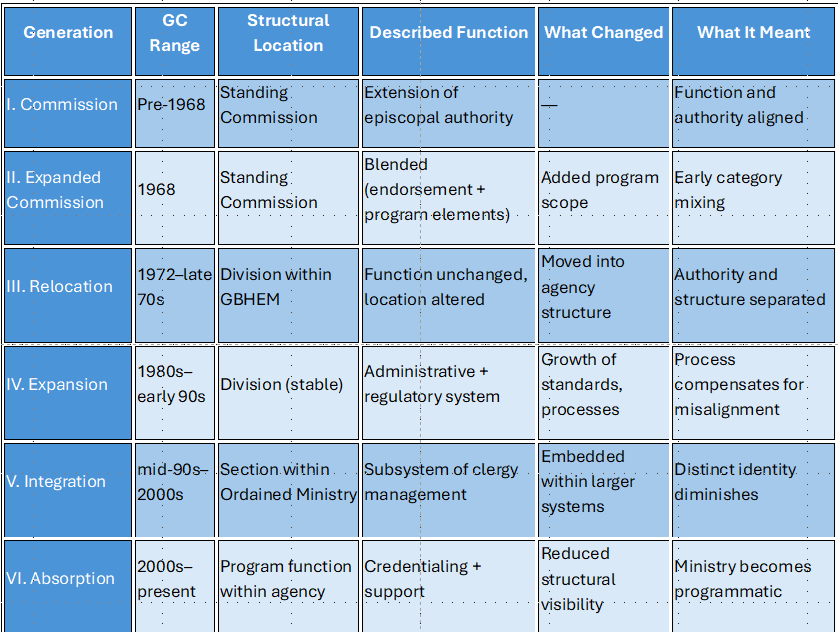
The ministry that once stood as a distinct expression of the Church’s work is now situated within layers of structure that were designed for broader programmatic purposes. Governance remains present, but it is exercised at a level removed from the ministry itself. The connection to episcopal authority is still real, but it is mediated through those structures rather than held in direct proximity to the work.
A ministry can continue to function under those conditions. In many ways, this one has. Clergy have been endorsed, supported, and sustained in their work. Institutions have continued to recognize the Church’s role. The practical work has not ceased.
But over time, the question becomes harder to answer clearly. Who holds this ministry? Not in a general sense, but in a way that can be named, located, and sustained over time. That question does not arise from a failure of the work. It arises from the cumulative effect of structural decisions that have made the locus of responsibility less distinct.
And that brings us back to the point where we began.
If endorsement is not simply a credentialing function, but the means by which the Church remains connected to those it sends, then the clarity of its governance is not incidental. It is essential to the coherence of the ministry itself.
The question, then, is not whether the work continues. It is whether it is being held in a way that matches what it is.
If the question is where this ministry is held, the answer cannot be found simply by naming the office or the agency where its work is assigned. It requires asking whether the structure in which it resides is able to hold together what the ministry itself requires.
At its center, the ministry of endorsement brings together three things that are not easily separated: the authority to send, the responsibility to stand behind those who are sent, and the ongoing accountability that connects the two. These are not abstract concerns. They are the practical conditions under which clergy are able to serve in settings where the Church is not otherwise present.
When those elements are clearly held, the ministry is coherent. When they are dispersed across structures that do not naturally bring them together, the work may continue, but the clarity of responsibility becomes harder to sustain.
That does not mean the current arrangements are without value. Program agencies provide important support. They develop standards, maintain relationships with institutions, and offer resources that individual conferences or bishops could not easily provide on their own. The work they do has enabled the ministry to continue across a wide range of settings.
But support and governance are not the same thing. A ministry can be supported by many parts of the Church. It still requires a place where responsibility is clearly held—where authority and accountability are brought together in a way that can be named and sustained over time.
For the ministry of endorsement, that requirement is not incidental. It arises from the nature of the work itself. If clergy are sent by the Church into institutional settings, then the Church must remain connected to them in a way that is more than administrative. It must be able to speak for them, to stand behind them, and to receive their ministry as part of its own life.
In our tradition, the authority to send belongs to the episcopacy. Clergy are appointed, not self-deployed. That act of sending carries with it a continuing responsibility—not only to authorize ministry, but to remain accountable for it.
If that is the case, then the ministry that sustains that relationship cannot be fully understood apart from that authority. It is not simply a function to be supported. It is a responsibility to be held in direct relationship to those who send—that is, in proximity to the episcopal authority from which it arises.
Many of the Church’s ministries can be distributed across its structures. Some, however, require a more clearly held locus of responsibility. The ministry of endorsement appears to be one of these.
At earlier points in the Church’s life, that proximity between the ministry of endorsement and episcopal authority was more directly expressed in its structure. Over time, that connection has been maintained in practice, even as it has become less explicit in form.
That kind of relationship does not sustain itself. It has to be located within the Church’s life—clearly enough that responsibility can be named, exercised, and maintained over time.
This is where the question of structure becomes practical rather than theoretical. Is there a place within the Church’s life where this responsibility is clearly located? Is there an identifiable office in which authority and accountability are held together—not only in principle, but in practice?
Those questions do not presume a single answer. The Church’s structures have changed before, and they will continue to change. What matters is not the form itself, but whether the form is able to carry what the ministry requires.
If the pattern traced here suggests anything, it is that the work has continued even as its structural location has shifted. That continuity is a strength. It reflects the Church’s commitment to those it sends.
At the same time, the gradual compression of the ministry within broader structures has made it more difficult to see where responsibility rests. What was once clearly located has become more diffuse.
To name that is not to call for a return to a previous form, nor to prescribe a particular solution. It is simply to recognize that the alignment between a ministry and the structure that holds it is not guaranteed. It must be considered.
The question, then, is a modest one, but an important one.
If this ministry is to continue—and for the sake of the relationships it sustains, both within the Church and beyond it, it must—how should it be held so that its authority, its responsibility, and its accountability remain clearly joined, and so that the knowledge required to sustain that relationship remains close at hand?
That is a question for discernment.
It is also a question of governance.