The Ministry of Ecclesiastical Endorsement: Location and Language - Part 2
What the Church Says It Is
Language, Practice, and the Ministry of Endorsement
Part 2 of the Location and Language Series
The Book of Discipline does more than organize the work of the Church. It describes, in practical terms, what the Church understands itself to be doing. Its language does not simply assign responsibilities; it reflects how those responsibilities are conceived, carried out, and sustained over time.
When that language changes, the work may continue. But the way the work is understood often changes with it.
This is especially true in areas of the Church’s life that are not widely seen. The ministry of ecclesiastical endorsement is one of these. For many within the Church, it remains largely out of view, encountered only indirectly through the presence of chaplains serving in institutional settings. As a result, the language of the Discipline plays a larger role in shaping how the ministry is perceived than it might in more visible areas of the Church’s life.
When that language is read across time, a pattern begins to emerge.
In earlier forms, the Discipline speaks with relative economy about this work. Responsibilities are named but not extensively described. Relationships are assumed. The connection between those who send and those who are sent is present in the language, but it is not elaborated in detail. The work appears to have been carried, in large part, through shared understanding and established practice.
Over time, that begins to change.
As the ministry is relocated within broader structures—from independent commission to general agency division—the language of the Discipline becomes more explicit. Responsibilities that had once been assumed are described in greater detail. Processes are articulated. Standards are clarified. What had been carried through practice and relationship comes to require description through policy and procedure.
This shift does not necessarily reflect a change in the existence of the ministry. Clergy continue to be endorsed. Institutions continue to receive them. The Church continues to stand behind those it sends.
What changes is how that work is described.
Across successive revisions, the language surrounding endorsement becomes more closely aligned with programmatic and process-oriented categories. The emphasis moves from naming a relationship grounded in authority and accountability to describing processes that can be organized, administered, and sustained within broader agency structures.
The effect is gradual, and it is not always immediately apparent in any single revision. But viewed across time, the pattern becomes clearer.
The following summary traces these developments across several generations of the Church’s life, making visible not only structural changes, but the shifting language by which the ministry is described.
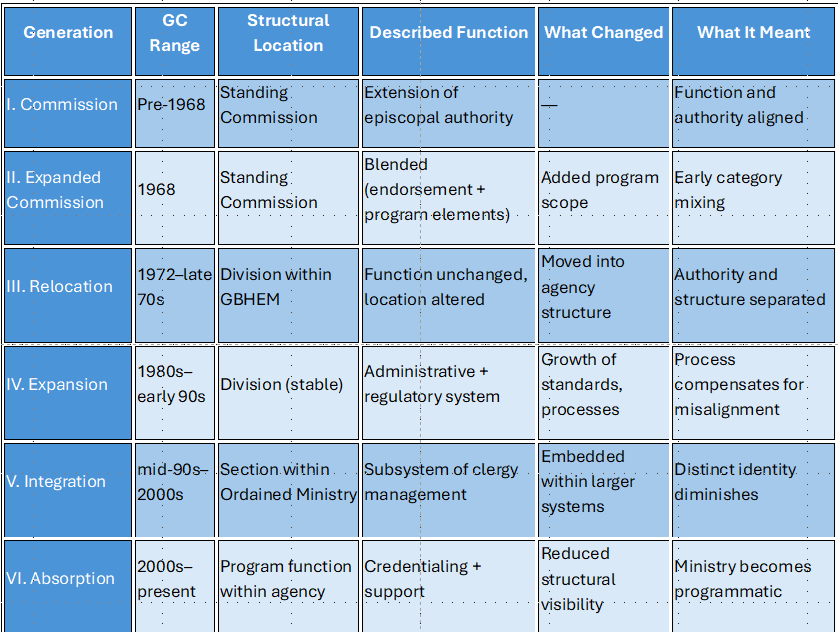
Viewed together, these revisions reveal more than structural movement. They show a gradual shift in how the ministry is understood and described. Earlier language assumes a relationship—between those who send and those who are sent, between the Church and the settings in which its clergy serve. Responsibility is present, but not extensively elaborated. It appears to be understood as part of the work itself.
Over time, that assumption gives way to description.
As the ministry is situated within broader agency structures, the language increasingly reflects the needs of those structures. When a ministry is held within programmatic structures, it is increasingly described in terms those structures are designed to sustain. Processes are articulated. Standards are clarified. Responsibilities that had once been carried through shared understanding come to require written form.
This development is not difficult to explain. As continuity of practice diminishes, description becomes necessary. Where a ministry is no longer sustained through direct participation and shared experience, it must be preserved through increasingly explicit language.
But this shift does more than clarify the work—it begins to redefine it.
What can be described most easily are the elements that can be organized, administered, and measured. These remain visible in the language. The elements sustained through relationship—authority, accountability, care, and the ongoing connection between the Church and those it sends—become less prominent. They do not disappear from practice, but they recede from description.
And over time, what is described begins to shape what is recognized.
Taken together, these shifts in language do not suggest that the ministry of endorsement has disappeared. The work continues. Clergy are endorsed. Institutions receive them. The Church remains present in settings where it is not otherwise gathered.
What has changed is how that work is described—and, over time, how it is understood.
Where earlier language assumed a relationship grounded in the Church’s act of sending, later language more often describes the processes by which that work is organized and sustained. Both are necessary. A ministry that operates across diverse institutional settings requires clarity, consistency, and coordination.
At the same time, description shapes recognition.
When the language of a ministry emphasizes its processes, it is more readily perceived as something to be administered. When it emphasizes its relationships, it is more readily understood as something to be held—by those who bear responsibility for it and remain accountable for its exercise.
Over time, as the language of endorsement has become more closely aligned with programmatic and process-oriented forms, the earlier emphasis on authority, accountability, and the ongoing relationship between the Church and those it sends has become less explicit. It has not disappeared. But it is no longer foregrounded in the same way.
A further indication of this shift can be seen in the most recent language of the Discipline.
In its current form, the ministry of endorsement is referenced only briefly within the responsibilities of the General Board of Higher Education and Ministry. It is described in terms of support and advocacy for endorsed clergy, and in terms of granting and removing endorsement where required.
Notably absent is any direct articulation of the ministry itself. The language does not name endorsement as a distinct expression of the Church’s work, nor does it explicitly connect it to the Church’s act of sending or to the authority by which that act is carried out.
What remains is a description of functions—actions that can be performed within an administrative framework. The relational and authority-based dimensions that had once been more clearly present are not directly expressed.
This does not mean those dimensions have ceased to exist in practice. But it does suggest that, in the language of the Discipline, the ministry is now most readily encountered in its most administrable form.
For those who encounter the ministry primarily through the words of the Discipline, that shift matters. What is named clearly is more easily recognized. What is not named as directly is more easily overlooked.
And what is more easily overlooked can, over time, be treated as less central—less connected to the Church’s core responsibilities, and more easily located within structures designed to administer rather than to hold.
The ministry remains.
The question is whether the language that describes it continues to reflect its full meaning.